Securing Life: Exploring more-than-human care amid ecological precarity
As contemporary environmental challenges, infectious diseases, and biosecurity interventions increasingly complicate multispecies relations, this symposium examines how environmental care and ecological governance are co-produced through situated knowledge and embodied practices. Drawing on anthropological and geographical research on livestock metabolism, wildlife management, and everyday grassroots care within local communities, we seek new approaches to resilience that attend to the social, material, and more-than-human dimensions of living with infectious and environmental threats.
Date: November 14, 2026, 1400-1800
Venue: Eike University of Hiroshima, 6th Floor, Room 602/603
Program
14:00-14:05 Introduction: Makoto Nishi (Hiroshima University)
14:05-14:15 Welcome: Maki Kitagawa (National Museum of Ethnology)
14:15-15:00 Else Vogel (University of Amsterdam)
Cows, Grass, and Soil: The Metabolic Politics of Grazing in the Netherlands
Many associate the Netherlands with the image of a black-and-white cow in a meadow. This talk analyses this image as a precarious multispecies achievement involving shifting registers of valuing cows, land, and grass. Drawing on ethnographic research in the Dutch dairy sector, and scholarship on the metabolic politics, I interrogate how cow-land relations in the Netherlands are rethought and reconfigured through public-private efforts to sustain grazing. These efforts combine commitments to animal welfare, dairy markets, Dutch landscapes and, increasingly, biodiversity and climate. I focus on how veterinarians and farmers grapple with the craft of grazing, negotiating highly productive dairy cows’ nutritional needs alongside care for the soil and surrounding nature areas. These practices recast the farm’s metabolic polis and its spatial anchoring: who feeds whom, which transformations are fostered and problematized, and where digestive relations should extend. The emerging ecologies of production do not escape industrialisation but reorient the metabolic relations of intensified food production.
15:00-15:45 Kieran O’Mahony (Czech Academy of Sciences)
Fever Dreams: The pathogenic politics of possible pig worlds
African swine fever (ASF) has profoundly reshaped relations between pigs, people and landscapes across its global geographies. Histories of the disease reveal how epidemiological knowledge and interventions intersect with agricultural economies, political authority and competing valuations of porcine life, often with disruptive and violent consequences. Yet, like many other infectious diseases, ASF also exerts considerable force in places where the disease remains an anticipated rather than realised threat. Drawing on ethnographic research, this paper explores how the uneven histories and geographies of ASF intersect with contemporary biosecurity imaginaries in Britain, where the unofficial return of wild boar has generated new ecological possibilities alongside anxieties surrounding infectious disease. I consider how the prospect of ASF is made present through anticipatory infrastructures of preparedness, surveillance and intervention; through everyday concerns surrounding feeding, metabolism and the movements of pigs and pork; and through lingering memories of past disease disasters. In doing so, I consider how the anticipation of pathogenic futures shapes the kinds of porcine worlds that become imagined, desired or made possible. What happens when the appetites, movements and ecological relations through which pigs make their lives become increasingly understood as potential pathways of contagion? And how might these pathogenic imaginaries reconfigure more-than-human vulnerabilities and existing practices of care and environmental governance?
15:45-16:15 Tea break
16:15-17:00 Gergely Mohácsi (The University of Osaka)
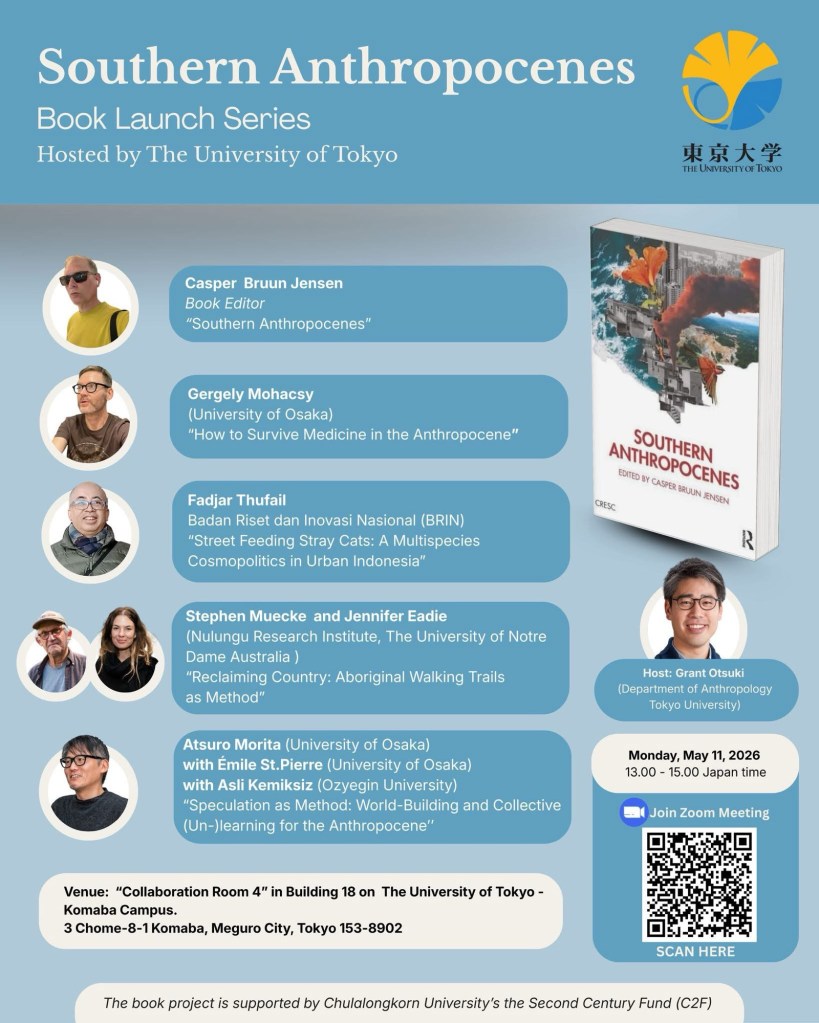
Local Food, Terrestrial Health, or How to Survive Medicine in the Anthropocene?
Disease has become a way of inhabiting, and ruining, the planet. Take pharmaceuticals, for example. The flow of excreted livestock antibiotics through metabolic networks illustrates the limits of conventional biosecurity and complicates multispecies relations. Exploring more-than-human care amid ecological disturbance, this paper frames grassroots ecological reparation as a critical site of environmental and public health governance. Drawing on preliminary results from an ongoing ethnographic study in the Seto Inland Sea region, I will examine the role of nutrition in the public and ecological health of local fishing communities. Food localization, as a situated and embodied response to biodiversity loss, shows how everyday dietary practices connect local ecosystems to global environmental threats. I will argue that surviving medicine in the Anthropocene depends on shared infrastructural and ecological care.
17:00-17:20 Discussant: Akinori Hamada (The University of Tokyo)
17:20-18:00 ディスカッション