グローバル・ローカル・惑星

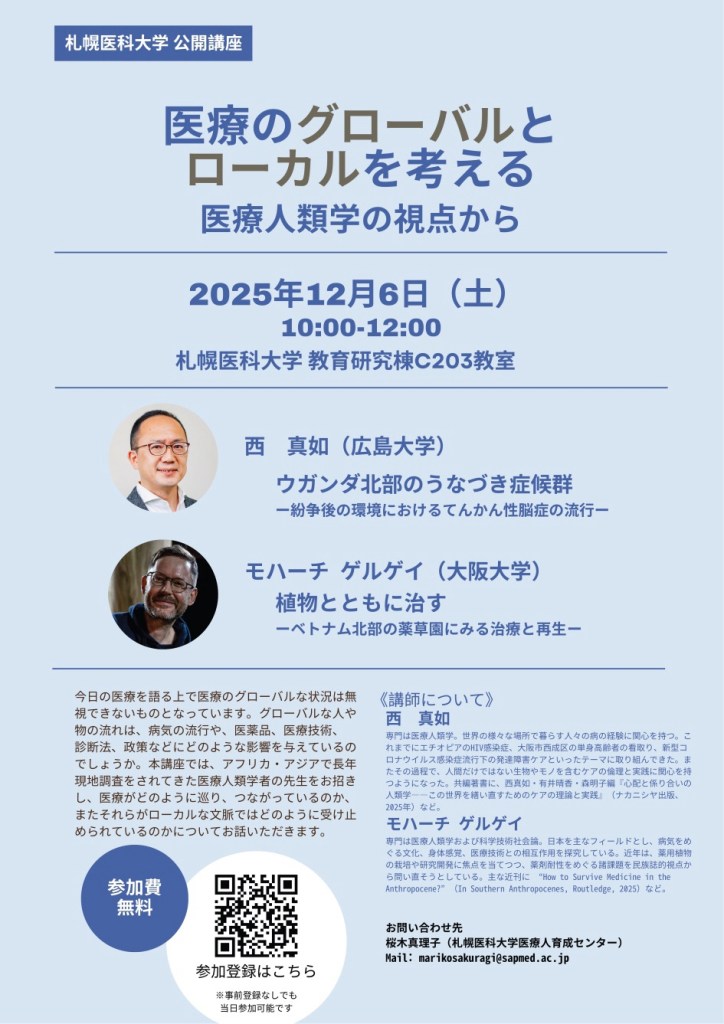
明日、久しぶりに札幌で講演する機会をいただきました。筑波大と京大と阪大の医療人類学が、不思議な形で絡み合う(関わり合う?)ことになる見込み。日本語と英語で書いた最近の論文を組み合わせてみるという、初めての試みです。終わってからはスキー場へ?

医療のグローバルとローカルを考える:医療人類学の視点から
関連URL:https://web.sapmed.ac.jp/jp/news/event/e246pi0000000t1l.html

日時:2025年12月6日(土)10:00-12:00

場所:札幌医科大学教育研究棟C203教室

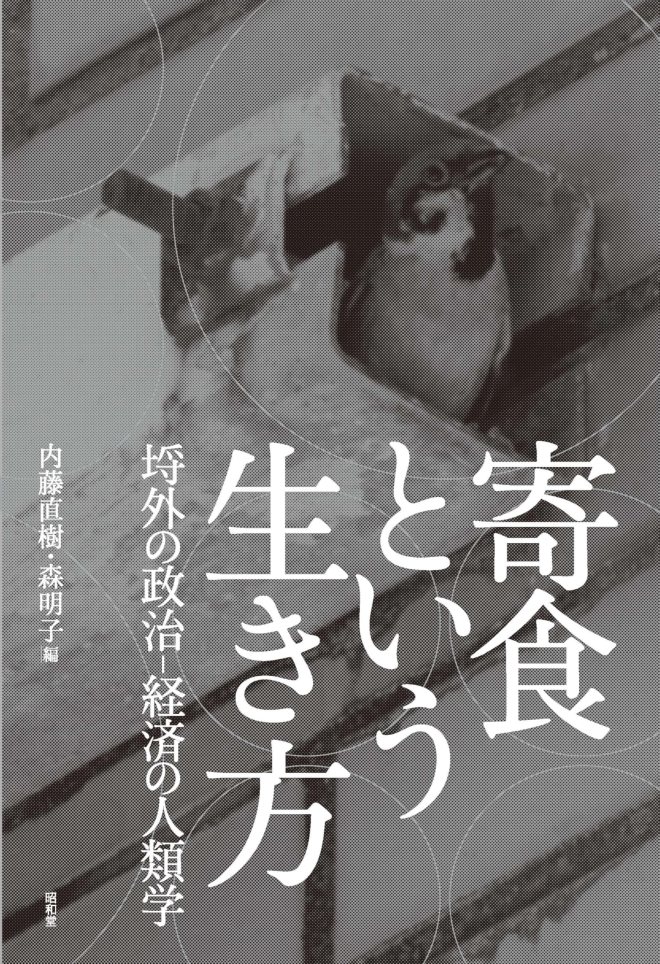
寄食という生き方

——埒外の政治‐経済の人類学力

コロナ禍元年より継続してきたみんぱく共同研究プロジェクトの成果として刊行された本書では、人類学者、歴史家、生態学者とともに、人間と人間以外の生き物が互いに食い合い、結びつき合う中に潜む政治性について考察しています。私が担当した第17章「地球への薬効――薬用植物から考える公共空間の生態学」では、ハノイ市内の薬草園を舞台に、医薬品に汚染された土壌の改良から始まる薬草栽培の実践を紹介し、病と健康をめぐる再生の可能性を探っています。

http://www.showado-kyoto.jp/book/b656843.html

編者:内藤直樹・森明子

2025年3月31日発売
A5判・412頁
定価:本体5,720円+税
ISBN 9784812224168

従来の政治や経済の論理をはみ出た存在、寄食者を断罪するのではなく彼らの論理や実践に目を向け様々な価値観に開かれた理解を目指す。

Decomposing the Anthropocene

I was invited to this exciting workshop at the University of Tokyo in February as a discussant. Looks like there are other fellow anthropologists out there exploring the role of chemicals in making humans healthy and/or sick. Jump in if you’re interested in the topic and happen to be in the area!

Event page HERE

UTokyo Cultural Anthropology Seminar/COVID-19 and Humanities International Symposium

Decomposing the Anthropocene

Exploring Chemical Ethics Beyond the Laboratory

Chemical ethics is often considered a nascent area in which chemists think of ethical guidelines for conducting chemical research. However, as recent debates on the Anthropocene and metabolism have made clear, it is not only chemists who produce, consume, and emit chemicals. Also, as the various studies in chemo-ethnography have revealed, attention to the distribution and dispersal of chemical substances in the environment has become essential when thinking about the lives of humans and non-humans. Therefore, this symposium examines the everyday ethics of chemical-entangled beings based on examples from East Africa and Japan. Through this endeavor, it offers the unique opportunity to reexamine the Anthropocene from a more concrete and especially microscopic level.

Date: 4th Feb, 2024 (Sun), 2 pm to 6 pm

Venue: Collaboration Room1 4th floor on Building 18 in Komaba Campus, University of Tokyo(HYBRID Onsite+Online)

Chair: Maki Kitagawa (University of Tokyo)

14:00 – 14:15 Introduction: Akinori Hamada (University of Tokyo)

14:15 – 15:00 Paper 1 : Wenzel Geissler / Ruth Prince (University of Oslo) “Tracing the metabolites of history: studying the toxic aftermath of the1950s Pare-Taveta malaria eradication experiment”

15:00 – 15:45 Paper 2 : Mayumi Fukunaga (University of Tokyo) “Terra-reforming for socio-ecological salvation: Ways of governing aquatic nutrients for healing a stranger sea”

15:45 – 16:15 Break

16:15 – 17:00 Paper 3 : Ruth Prince (University of Oslo) “Toxic exposures and urban living: notes from Kisumu, Kenya”

17:00 – 17:20 Comment: Gergely Mohacsi (Osaka University)

17:20 – 18:00 Discussion

18:00 – Social Gathering

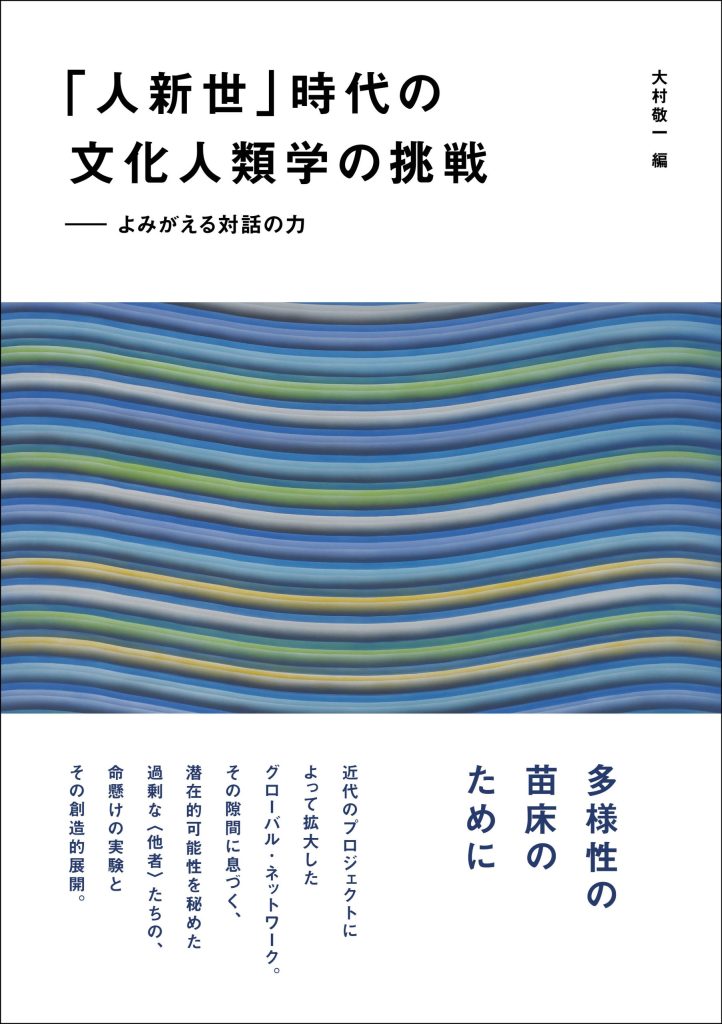
「人新世」時代の文化人類学の挑戦

——よみがえる対話の力

いつもとはちょっと違う取り組みです。放送大学の授業のために用意した教材を対談形式で学術書に変身しました。プラネタリーヘルスと多種共生民俗誌の二つの章を担当してきました。ご関心のある方、お目を通しくださいね。

http://www.ibunsha.co.jp/books/978-4753103812/

編者:大村敬一

2023年12月25日発売
A5判 並製カバー装 464頁
定価:本体4,800円+税
ISBN 978-4-7531-0381-2

近代化の網の目からこぼれ落ちる、過剰なる他者たちの営みから、いかに人類の想像力の可能性を見出すか──。 総勢12名の人類学者が対話・インタビュー形式で「人新世」時代を語る、最新の研究動向に迫る論集。

Embodied Value Theory

February seems to be the month for international workshop. This 1, of which I’m proud to be a discussant, is organized by The Anthropological Institute of Hiroshima (TAIHI) and revolves around two quite specific themes dear to my heart: #incommensurability and #embodiment. It is probably the first time for me to visit Hiroshima University not as an instructor, but a researcher—except the annual meeting of the Japanese Anthropological Association, which was held here some years ago. Feel free to join us either at the venue or online!

https://taihi.org/events/stefan-ecks/

The Anthropological Institute of Hiroshima (TAIHI) is pleased to announce a lecture by Dr. Stefan Ecks on embodied value theory, the novel anthropological theory that explains how living entities value life by way of commensuration. The lecture will take place at Hiroshima University at 4:00 p.m. JST on February 20, 2023. You are invited to take part either at the venue or online. Please kindly register your name in advance by submitting the form below.

Embodied Value Theory

Value theory has always been part of anthropological theory, but only implicitly. ‘Culture’ was basically defined as a pattern of values. An explicit anthropological discussion of value is fairly recent. Some believe that a general value theory can be achieved. Others think that anthropology is all about discovering cultural incommensurabilities that cannot contain a universal notion of value. The greatest conceptual challenge is if cultural values (in the plural) can be synthesized with economic and exchange-based value (in the singular). Here I argue that values and value can be brought together within an embodied value theory (EVT). At the core of this new theory of value is embodied life as the ground and goal of valuing. Life values living, and life tries to make the most of life by valuing different possibilities. I show that all valuing rests on comparisons, and that the infinite similarities between different entities can only be decided in pragmatic contexts. I propose that biocommensurations, where at least one entity in a comparison is alive, is the universal form of valuing.

Date: February 20, 2023, 4:00-6:00 p.m. JST

Venue: Hiroshima University, Higashi-Senda Innovative Research Center (2nd Floor, Room M204) and online (Zoom)

Program :
4:00-5:00 p.m. Lecture by Dr. Stefan Ecks
5:00-6:00 p.m. Comments followed by open discussion

Commentators :
Akinori Hamada (Tokyo University)
Mohacsi Gergely (Osaka University)

Moderator :
Makoto Nishi (Hiroshima University)

気候変動時代における「人間」を問う:人新世と人間科学

人間科学サミットin OSAKA|「人間科学を知ろう」

 2022年 大阪大学人間科学部創立50周年

  • オーガナイザー:モハーチ ゲルゲイ(大阪大学人間科学研究科)
  • 日時:2022年12月3日(土曜)13:15~15:15
  • 場所:大阪市中央公会堂、1F 大集会室
  • キーワード:人新世、草の根の社会運動、気候変動、レジリエンス、環境人間科学

概要:可能な世界を目指す草の根の社会運動の関係に焦点を当てて、〈惑星的なもの〉と〈人間的なもの〉の間の変化する関係を探ることを試みる。地球そのものが人間の生息環境となるという歴史的な変革を概説してから、気候変動にともなう社会生態系の崩壊と再生の事例を踏まえて、大阪大学オムニサイト(OOS)プロジェクトとして活躍する「工藝の森」という取り組みについて紹介する。最後のラウンドテーブルでは、オーガナイザーと発表者5名が、気候変動時代における人間科学の課題と可能性について討論を行う。

【メッセージ】

「環境問題は若者が関心を持っているテーマだと私は思います。環境汚染、生物多様性、気候変動なら工学や自然科学を学ぶということを考える学生のみなさんには、人間科学も視野に入れてほしい。人間科学においても、環境や生態系に対する意識は近年の研究動向として無視できないものになっています。今回のシンポジウムはこのような研究動向を紹介しますので、環境問題に興味を持つみなさんにぜひ来ていただきたいと思います。」(モハーチ ゲルゲイ)

【プログラム】

13:15~13:30 挨拶・趣旨説明(※日本語)

モハーチ ゲルゲイ(大阪大学人間科学研究科・准教授)

13:30~13:55 話題提供① 思想としての地球|Planetary Visions(※English)

Anders Blok (U of Copenhagen, Dept of Sociology, Associate Professor)

13:55~14:20 話題提供② ローカルな実験|Local Experiments(※日本語)

ケミクスィズ アスル(大阪大学人間科学研究科・特任研究員)

14:20~14:45 事例紹介③ 物質と循環型社会|Material Flows(※日本語)

高室 幸子(一般社団法人パースペクティブ 共同代表)

森田 敦郎(大阪大学人間科学研究科・教授)  

14:45~15:15 討論 気候変動時代における人間科学の課題と可能性(※日本語&English)

I 思想としての地球|Planetary Visions

Eventful Anthropocene: On contingent temporalities of urban-ecological activism in times of climate change

Anders Blok (U of Copenhagen, Dept of Sociology, Associate Professor

ABSTRACT: The notion of the Anthropocene has given rise to widely divergent interpretations and responses in socio-cultural theory. In this paper, I develop the notion of an ‘eventful’ Anthropocene, broadly following how philosopher Isabelle Stengers has presented Gaia, a figure capturing today’s planetary ecological crises, as an event in collective historicity. I develop my argument in three steps. First, drawing on work with Casper Bruun Jensen, I contrast Stengers’ approach, informed by science and technology studies (STS), to the rather more ‘event-less’ approaches to rethinking nature-culture relations found in so-called new materialism and eco-Marxism, respectively. Second, I expand on the notion of ‘the eventful’, by invoking how historian and social theorist William H. Sewell Jr. conceptualize temporality as contingent, complicated and heterogenous, and as unfolding at the intersection of multiple processes, relations and causalities. Third, I illustrate some implications of an eventful approach to the Anthropocene by drawing on a collaborate case study into urban-ecological activism in Copenhagen, Denmark, working to unearth or ‘daylight’ a nowadays channelized waterbody flowing underneath the city. Centrally at stake in this activist endeavour, I suggest, are a series of temporalities likely characteristic of Anthropocene sensibilities, coming together in efforts to recast pasts and futures beyond urban-modernist commitments. Paying attention to such Anthropocene temporalities, I conclude, provides one situated illustration of the wider learning process in which socio-cultural analysis and theory finds itself vis-à-vis the Anthropocene – one in which, as Stengers says, theoretical certainties must be put at risk anew.

Ⅱ ローカルな実験|Local Experiments

An Island Community in Crisis: The breakdown of the “local”

Asli Kemiksiz (Osaka University, Dept of Anthropology, Research Associate) 

ケミクスィズ アスル(大阪大学人間科学研究科・特任研究員)

ABSTRACT: This talk focuses on a case study of a small island in Turkey, after the simultaneous crises of environmental destruction and the Covid-19 pandemic. The Sea of Marmara is an inland sea in the Northwest of Turkey. It is connected to both the Black Sea and the Aegean (thus Mediterranean), making it an important international sea route. Due to decades of pollution, environmental damage, and sea temperatures rising, the sea had been affected by a “sea snot” or “marine mucilage” bloom of historic proportions in the summer of 2021. The marine mucilage bloom lasted for months, affecting large swathes of sea and even neighboring seas, finally sinking to the sea floor. The impact of the disaster was multifaceted, the environmental damage being the worst. But the region was also already suffering from multiple other crises including the global pandemic, which impacted the lives and livelihoods of the people immensely. So in this talk, I will introduce a tiny island called Ekinlik, which has gone through drastic changes in the last few years due to droughts, economic instability, infrastructural change, pandemic, and so on. What can we learn about the vulnerabilities of the local in face of multiple entangled anthropogenic crises? Is the breakdown of an island community just a case, or a scale model for a planetary crisis scenario? 

Ⅲ 物質と循環型社会|Material Flows

人新世の環境変化と草の根のインフラストラクチャー

森田敦郎(大阪大学人間科学研究科・教授)& 高室幸子(一般社団法人パースペクティブ 共同代表)

概要:人新世の環境変化は、主に生産活動とそれにまつわるエネルギー、輸送、廃棄などのインフラストラクチャーからもたらされている。ネットワーク状に広がるコンクリートの空間であるインフラは、自然環境を大きく改変している。モノづくり、インフラ、環境の関係を再構築し、現在の環境破壊の趨勢を逆転することは可能なのだろうか?この発表では、一般社団法人パースペクティブの「工藝の森」の取組を通して、「つくること」と環境の関係を草の根から変えていく可能性について考える。

Mastodon, Day 0

Mastodon試–––なぜFedibirdというに着地したかと聞かれても、よくわからないけど、一応、漢字は魅力的なんだろう🙄もちろんひらがなやカタカナも。どこかに移動するときにまたここで伝えておく予定。

If you, like me, naively believe that communication is, among other things, also about community and the sharing of ideas, we may just as well meet on Mastodon—as long as it is a sufficiently decentralized and self-organised place to be.

Ha van egyáltalán bárki, aki hajlandó még ezen a kihalófélben lévő nyelven olvasni, és ráadásként még írni is esetleg, akkor jöhet utánam a Mastodon-ra. Nemtom, mi lesz belőle, de nyelvi mókákra alkalmasnak tűnik.