Infrastructure & Politics of Cohabitation (University of Toronto)

Infrastructure & Politics of Cohabitation (University of Toronto)

After the RESPECT summer school has finished, I’ll stay in Toronto for a couple of days more for this international workshop held jointly by UofT and Osaka University. The line-up is really exciting. I wonder how all these ideas around kyōsei resonate with the work done to infrastructure during the past couple of years by my colleagues and friends in Osaka. My talk, “Gardening the Future: On the cultivation of herbal medicines and planetary health” will deal with the multispecies entanglements of plants and humans through a comparison of two different experimental sites of herbal medications in Nara, Japan and Hanoi, Vietnam.

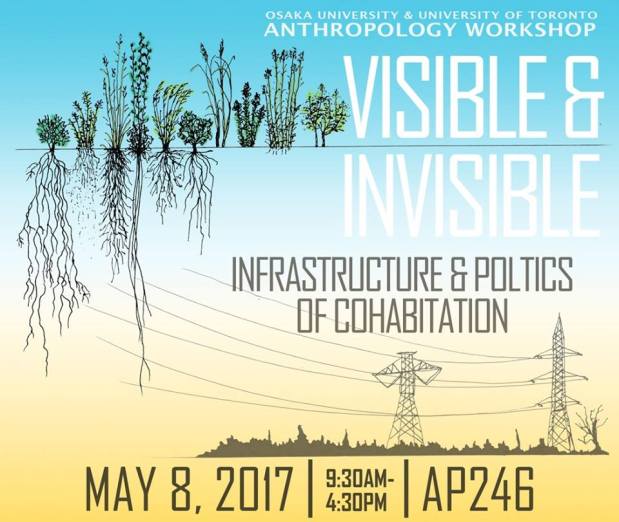
Visible & Invisible: An Open Workshop on Infrastructure & Politics of Cohabitation (University of Toronto)

Time: Monday, May 8, 2017, 9:30-16:30
Place: University of Toronto, Anthropology Building, AP 246
Organisers: Keiichi Omura, Shiho Satsuka, Bronwyn Frey, Brenton Buchanan & Johanna Pokorny
Participants: Michelle Murphy x Gergely Mohacsi; Andrea Muehlebach x Moe Nakazora; Bonnie McElhinny x Goro Yamazaki; Joshua Barker x Sho Morishita; with Atsuro Morita & Grant Otsuki

Continue reading

The 4th Kyosei Studies Colloquium (Osaka U.)

The last Kyosei Studies Colloquium this semester will be some kind of conversation between anthropologists from Japan and philosophers from France on the legacy of Eduardo Viveiros de Castro’s work. A bit over-ambitiously, I promised to give a paper titled “From a metabolic point of view: six notes on eating (folding) together.” Now, I’m trying to fold diabetes and cannibalism together, and see what happens… 

International Symposium on Viveiros de Castro, Metaphysics and Anthropology

Time: Friday, March 3, 2017, 13:00-19:00
Place: Osaka University, School of Human Sciences, East Wing, Room 207.
Organiser: Tatsuya Higaki
Fb event: https://www.facebook.com/events/981750475290179/

Continue reading

Organic Metaphors in Technoscience (UvA)

On the way back to Hungary, I’ll stop over in Amsterdam to give a paper at this interesting workshop. The title of my paper is: “Worlding with the Metabolism: Or how to ‘put’ Japanese medications into Hungarian bodies?” I’m working on the same material for a Japanese publication and will re-visit some of the sites back in Hungary, so it is a really special occasion. And meeting with old friends, of course… 


Organic Metaphors in Technoscience

Time: Friday, September 16, 2016, 14:00-17:30
Place: University of Amsterdam, Department of Anthropology, B building, Room B5.12
Organisers: Atsuro Morita, Liv Nyland Krause and Wakana Suzuki
.
ABSTRACT: Recent discourses about innovation and management are full of organic metaphors. From innovation ecosystems to business incubation to digital ecology, terms from biological and ecological sciences are now widely used to denote practices and organizational processes of business and technoscience. This workshop aims to shed light on this trans-boundary displacement of organic notions by focusing on the intermingling of the semiotic and the material in technoscience. Organic metaphors of social processes have long history that stretches back to the early social organism theory in the 19th century and beyond. Anthropology has also paid attention to metaphors of body and organism in wide-ranging settings. This workshop tries to extend such classic interests further by focusing on material practices of making analogies between processes of life and other domains. From robotics and industrial district, many of recent organic metaphors aim not only to understand social processes by organic metaphors but also to create artifacts and social organizations functions like organisms. In other words, in these practices metaphors of life are taking material forms. By focusing on this performativity of such analogies, the papers of the workshop explore emerging intermingling of the mechanical and the organic, the imaginary and the material, and institutions and ecologies.

病・医療・生物医学(科学社会学会 第4回年次大会)

An STS take on my previous fieldwork in Hungary…

ハンガリーのフィールドワークを今回は科学技術論の視点から発表:

科学社会学会第4回年次大会 セッション3 @東京大学

◼︎ 日時:2015年10月10日(土)、15:45 – 17:45
◼︎ 場所:東京大学本郷キャンパス法文1号館
◼︎ 司会:山中浩司(大阪大学)

Continue reading

Human Scales and Subjectivities (TGSW 2015)

Another (and still preliminary) paper on my new material from Vietnam…

Session at the Tsukuba Science Week @ Tsukuba University

Time: Tuesday, September 29, 2015
Place: Tsukuba International Congress Center, 3F Conference Room 304
.
ABSTRACT: How can we assess the ways in which the humans (concerned persons, bystanders, experts, activists, administrators, and politicians) conceptualize the problems of the world? With what apparatuses – words, equipments, machines, bodies, conventions, social organizations, cultural values, symbiotic relations with living things and non-living things – do we conceive of our surrounding world and its difficult situations? (Is our surrounding world singular or plural?) With what temporalities – short-term events, individual life courses, social times, the annual budget cycles, business cycles, nature’s (and perceiving society’s) seasons, various half-lives of radioactive materials, long-term geological and evolutionary times – do we examine the longstanding issues? How can scientists (of different kinds) and anthropologists (of different kinds) constructively challenge each either to think in new ways about the many problems that face humanity? Our session takes up the notion of scales to explore such issues in concrete and in plural terms wherein we follow emerging contours of a problem of common concern. The question about the scales is, in the same instance, the question about the how of subjectivities. Take for instance; an immune system activated within our body transforms the contour of our individuality and subjectivity. The emerging subjectivity is no longer identical to our consciousness or will to be. The transformation of our environment as a result of, say, global warming or nuclear waste pollutions, inevitably has consequences in our intestinal microenvironment. Prostheses, including robotic devices and smart phones, attached to one’s body, transform the body and the embodied mind, and hence, the mode of existence in the world. In this session, we will be presenting concrete ethnographic cases related to these issues, in one way or another, which will be followed by a cross-disciplinary round-table discussion.

Continue reading